Designing the service ecosystem behind modern card payments
Shaping customer journeys and service blueprints across virtual cards, secure authentication, tokenisation, push provisioning and Tap to Pay — designing the service behind the payment, not just the interface on top of it.
- Organisation
- Absa Card & Payments
- Industry
- Banking / payments
- Scope
- Product strategy · Service design · Customer experience · Payments
- Areas
- Virtual cards · 3D Secure · Push provisioning · Tokenisation · Card enrolment · Tap to Pay
01 — The context
Payments are rarely a single-screen problem
Modern card and payment experiences sit across multiple layers: customer intent, authentication, device behaviour, card networks, banking systems, merchant interactions and internal operational processes.
The work required understanding not just what customers saw on screen, but how the service worked end to end.
02 — My remit
Working across the payment ecosystem
My work spanned multiple initiatives across the card and payments portfolio — virtual card consolidation, credit card lifecycle work, 3D Secure / SureCheck authentication, push provisioning, token lifecycle, card enrolment and Tap to Pay.
Across these, my contribution was understanding customer and service flows, shaping end-to-end journeys, service blueprinting, stakeholder alignment, discovery and analysis — translating complex service dependencies into clearer customer experiences. These were collaborative initiatives; my role was to make the service legible and the direction defensible.
03 — Understanding the system
Before designing the experience, understand the ecosystem
Structured discovery built a shared view of customer needs, payment behaviours, market alternatives, technology trends, value propositions and competitor approaches — before any solutioning.
Context map
Framed customer, market, technology and value-proposition considerations before solutioning.
Competitor analysis
Located the proposition against market alternatives and emerging payment behaviour.
Empathy map
Clarified customer needs, frictions and expectations around card and payment behaviour. Persona mapping kept journeys grounded in distinct payment behaviours rather than one generic user.
04 — Designing the service, not just the screen
The customer journey was only one layer of the service.
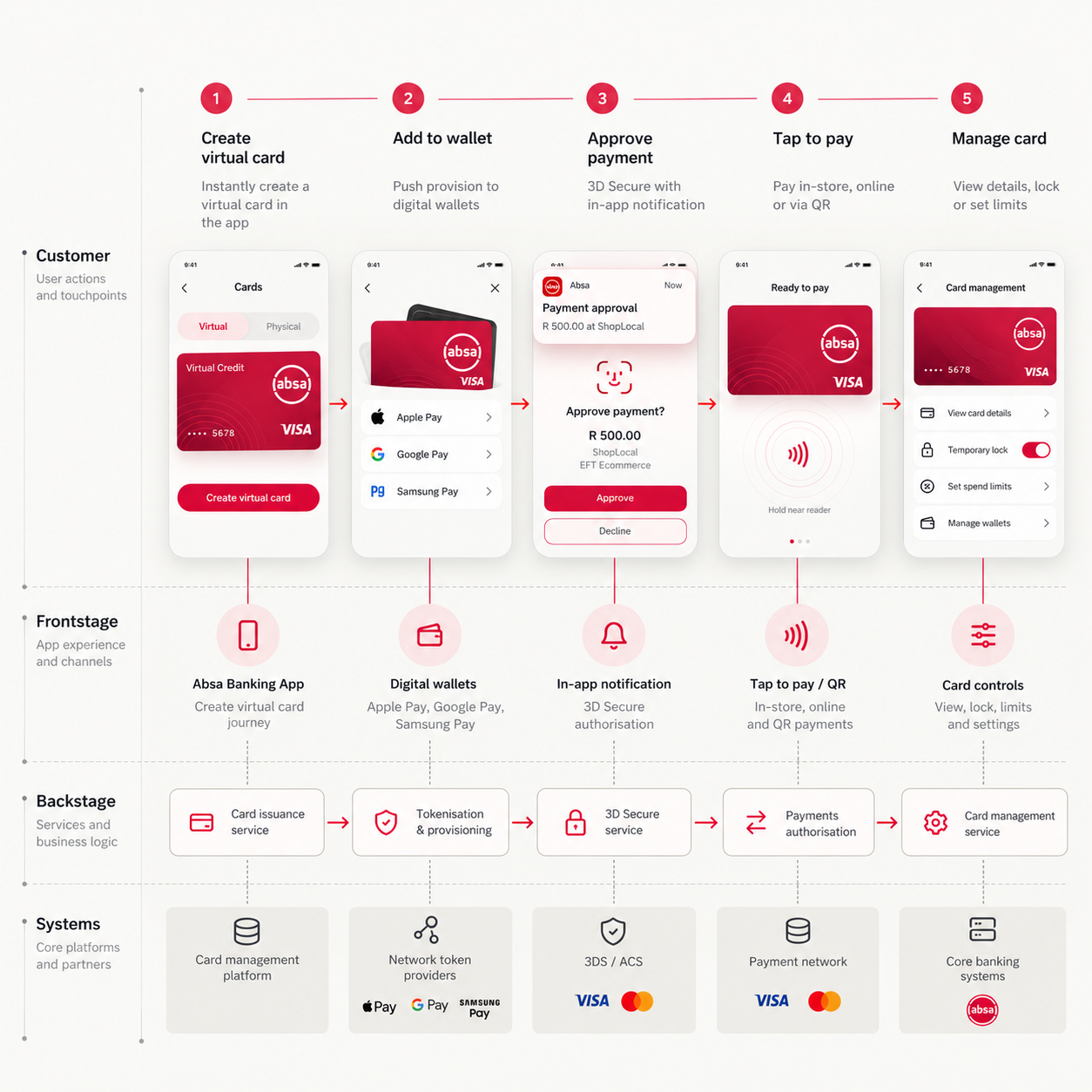
Customer journeys clarified the visible experience. Service blueprints exposed the supporting processes, systems, dependencies and organisational layers required to make those journeys work.
Push provisioning — customer journey
How a card reaches a wallet from the customer’s point of view.
Push provisioning — service blueprint
The backstage steps, systems and handoffs behind that single tap. Card enrolment was blueprinted the same way.
Tap to Pay — service blueprint
Device, merchant and network layers behind an in-person payment.
05 — Beyond the formal role
When the operating model had gaps, I worked across them
During this period some squads lacked product-owner or scrum-team capacity. I stepped beyond my formal design remit to help manage project expectations, stakeholder alignment and squad continuity so work could keep moving.
06 — Rebuilding trust
Restoring confidence in design through delivery
I took over work in a space where stakeholder trust in design had been weakened after significant team disruption.
On the 3D Secure / SureCheck work I built domain knowledge quickly, stabilised collaboration and rebuilt confidence with business and product stakeholders while continuing to deliver.
07 — What this work demonstrates
Complex products need more than interface thinking.
Good payment experiences depend on invisible systems working together.
Service design helps expose complexity before it becomes customer friction.
Senior product work often means operating across organisational boundaries, not staying inside a design lane.
08 — Carried forward
What this work reinforced for me
Understand the system before optimising the screen.
Map the service, not just the customer journey.
Leadership often shows up in the gaps between formal roles.